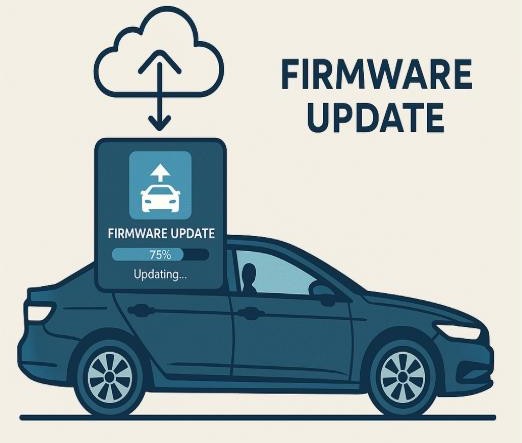
Ethernet–Based Bootloader

The Ethernet-Based Bootloader is a cutting-edge firmware update solution built for embedded and automotive systems requiring fast, secure, and remote software updates over Ethernet networks. It is ideal for connected ECUs, industrial controllers, and IoT-enabled automotive applications where system uptime and reliability are critical. Leveraging standard Ethernet protocols, it ensures easy integration into existing infrastructure while offering robust security and high-speed performance.

Ethernet Bootloader and Diagnostic services based on DoIP

Key Capabilities

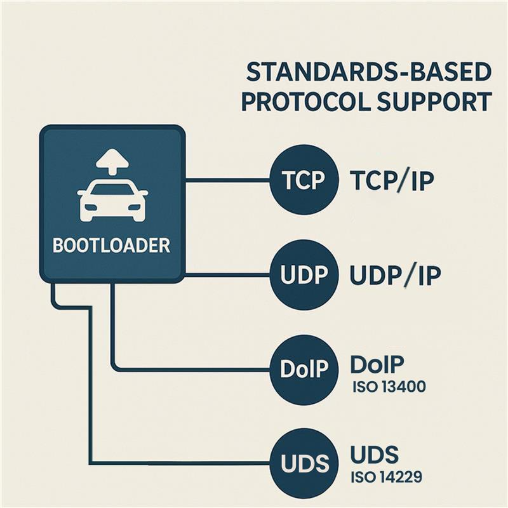
The bootloader is designed to work seamlessly with widely adopted communication protocols such as..
  • TCP/IP – Ensures reliable, connection-based communication.
  • UDP – Enables low-latency, connectionless transfers, Ideal for bootloader handshake and image transfer.
  • DoIP (Diagnostics over IP) – Fully supports ISO 13400-2, the automotive diagnostic protocol standard for Ethernet-based ECU communication. This makes the bootloader natively compatible with existing diagnostic tools and vehicle servicing infrastructure.
  • UDS (Unified Diagnostic Services) – Implements ISO 14229-1 standard, providing a structured and standardized framework for vehicle diagnostics. It supports essential services such as memory read/write, security access, and ECU reset, enabling robust and secure communication between diagnostic tools and the bootloader.
This standards-based protocol support ensures robust interoperability with OEM networks, backend diagnostic systems, and secure update servers.

High-Speed Transfers

Optimized for Ethernet bandwidth, this bootloader drastically reduces firmware transfer times compared to traditional Protocols (like CAN or LIN). The high data rate capability is especially beneficial for updating large binaries used in infotainment systems, ADAS modules, and domain controllers. This results in faster production line programming, quicker in-field updates, and minimized system downtime during maintenance.
{"prompt":"High-Speed data Transfers ","originalPrompt":"High-Speed data Transfers ","width":1024,"height":576,"seed":42,"model":"flux","enhance":false,"nologo":true,"negative_prompt":"undefined","nofeed":false,"safe":false,"quality":"medium","image":[],"transparent":false,"isMature":false,"isChild":false}

Secure Update Mechanism

Security is paramount in automotive software. The bootloader is built with a modular security framework that can be adapted to meet OEM-specific cybersecurity requirements, The current bootloader implementation incorporates these mechanisms:

CRC (Cyclic Redundancy Check)

For basic data integrity validation during transmission.

AES-128 (Advanced Encryption Standard)

Ensures confidentiality and secure delivery of firmware through symmetric encryption, widely accepted and compliant with ISO/IEC 18033-3.

While the framework is designed to be extensible to support additional OEM-specific security algorithms. Future enhancements may include: 

SHA (Secure Hash Algorithm)

Typically SHA-256, for message digest generation and robust integrity verification

RSA (Rivest–Shamir–Adleman)

Enables digital signature verification using public-key cryptography, ensuring authenticity and preventing unauthorized firmware modification.

HSM (Hardware Security Module) Integration

Supports integration with OEM-grade HSMs for secure key storage and hardware-accelerated cryptographic operations, in compliance with ISO 26262 and ISO/SAE 21434 for functional safety and cybersecurity

These layered security features ensure that only verified, untampered, and encrypted firmware is executed, aligning with modern automotive cybersecurity frameworks and regulatory standards.

Future Scope

Dual-Bank Flash Support

Dual-bank flash memory will allow the system to store both the current and new firmware images. In the event of an update failure or corruption, the bootloader can revert to the previously verified firmware version, ensuring the system remains operational. This fail-safe architecture is vital for vehicles and industrial systems where continuous operation is non-negotiable.

FOTA (Firmware Over-The-Air)

The bootloader architecture is designed to support future FOTA deployment using the MQTT protocol, enabling secure and efficient firmware updates over the air. Updates are delivered from a centralized server to an in-vehicle or edge gateway ECU via lightweight MQTT communication, ensuring reliable delivery even in bandwidth-constrained or intermittent network conditions.

HTTP/HTTPS

Widely used for secure client-server communication, supporting file downloads from cloud update servers with robust security and firewall compatibility.

SOME/IP (Scalable service-Oriented MiddlewarE over IP)

A service-oriented protocol standardized in AUTOSAR for vehicle communication, enabling efficient in-vehicle and backend communication in zonal or service-oriented architectures.

SOVD (Service-Oriented Vehicle Diagnostics)

Defined by ASAM and increasingly adopted in OEM diagnostic ecosystems, this modern protocol enables secure, standardized communication with vehicle services over IP for remote diagnostics and software management.

By supporting a modular protocol stack, the Ethernet-based bootloader can be customized to align with OEM’s backend infrastructure.

Minimized Downtime

Thanks to its remote update capability and high-speed transfer, devices can be updated in the field with minimal disruption to operations—critical for automotive applications where ECU availability directly affects vehicle functionality.

Reduced Support Costs

By enabling remote firmware updates and automated processes, the need for physical servicing or technician intervention is drastically reduced, cutting down on logistics and support expenses for manufacturers and fleet operators.

Enhanced Security

With robust validation steps including CRC checks and digital signatures, the system ensures that only trusted and verified firmware is executed. This protects devices against unauthorized code injection and malicious attacks, aligning with increasing regulatory demands for automotive cybersecurity.

Address

Crevavi Engineering Solutions Pvt Ltd.
#123/107 1st Floor Gokaram Rathnam Complex, 2nd Main, 27th Cross, Jayanagar 7th Block, Bengaluru Karnataka 560070

Contact

© Copyright 2025 Crevavi Engineering Solutions.
Scroll to Top