What Is miniHIL — and Why Does It Matter?
Early validation of embedded software is essential. miniHIL brings this capability directly into the developer workflow.
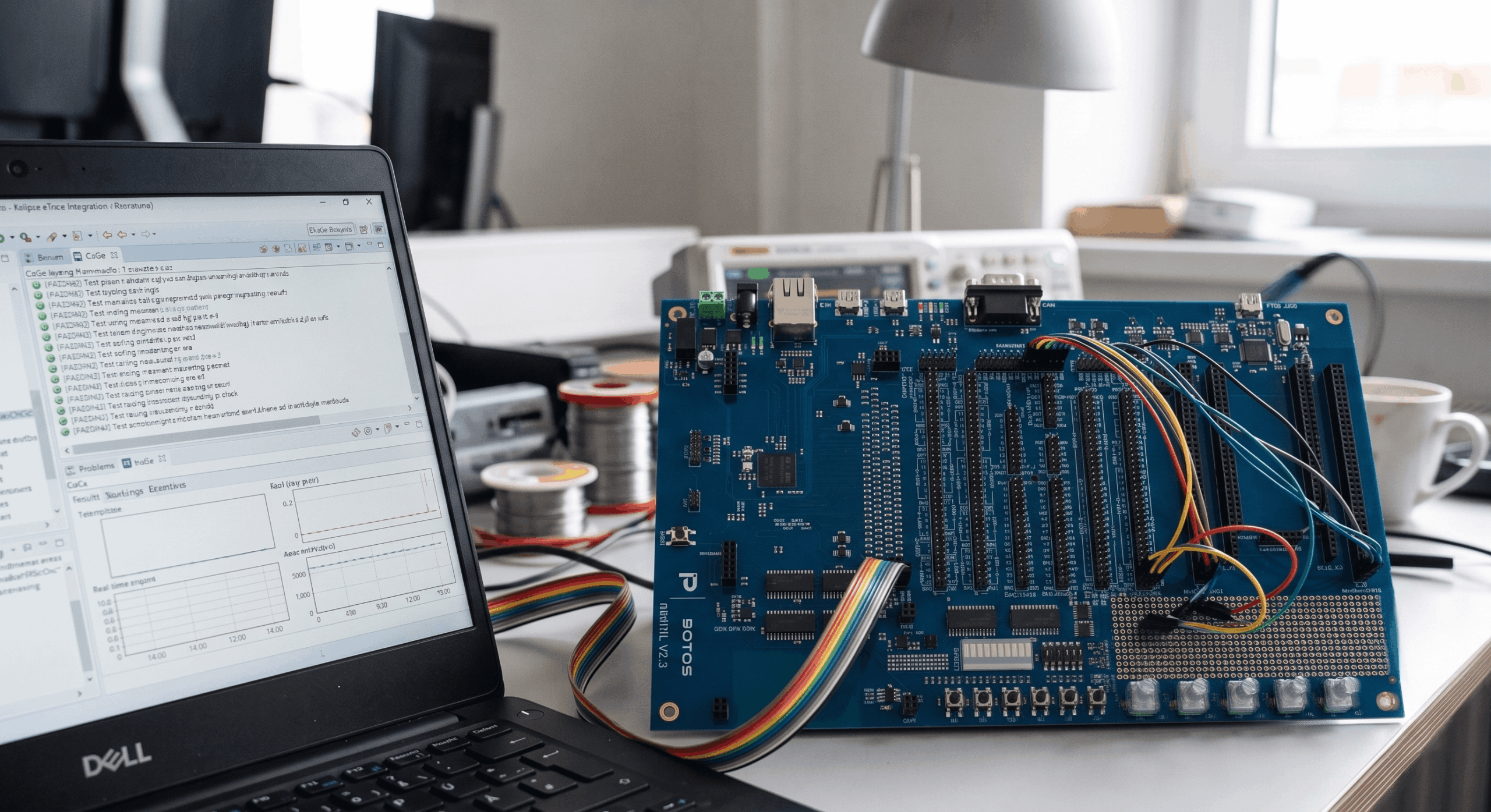
A bug found during implementation costs a few lines of code. The same bug found after release can cost millions — and in safety-critical systems, far more than money.
Meaningful hardware-level testing is routinely deferred because the tools are expensive, shared, and arrive late in the project cycle. miniHIL was built to break that pattern. Developed by PROTOS Software, it is a compact Hardware-in-the-Loop (HIL) system designed to sit on every developer's workbench and run tests after every code change — even before production ECU hardware exists.
miniHIL: Hardware-in-the-Loop for Every Developer
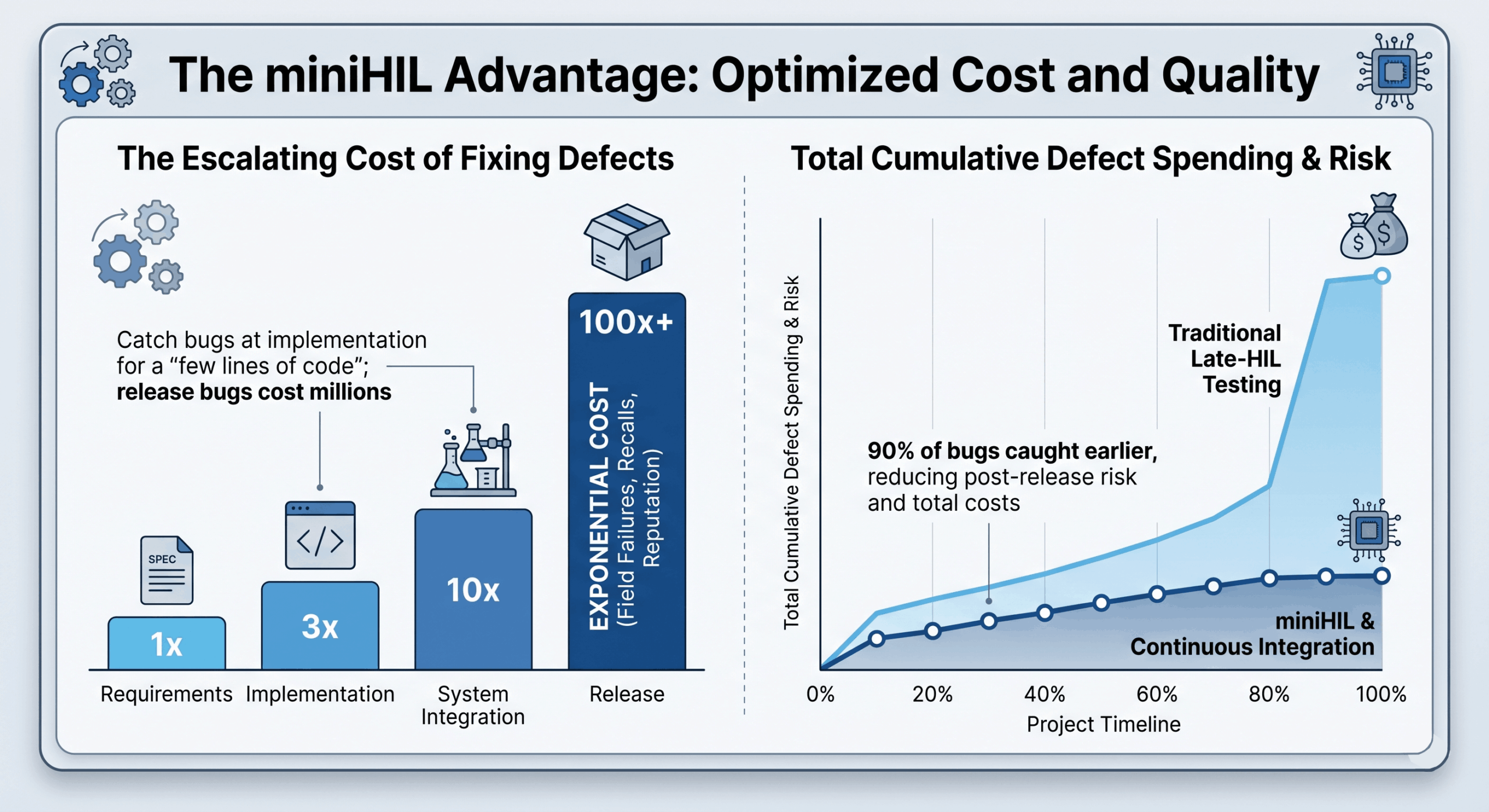
miniHIL is a complete HIL solution in an A4-sheet footprint. The hardware board interfaces the Device Under Test with a powerful STM32H7 simulation processor. A central patch panel connects the target microcontroller's physical pins to software models of the surrounding environment — sensors, actuators, and bus protocols running in real time.
From the firmware's perspective, it is receiving genuine sensor signals and actuator responses. It cannot distinguish simulated inputs from physical ones.
"The PROTOS miniHIL's purpose is to provide the tools necessary to perform HIL tests directly to developers, so that comprehensive testing can be performed at all stages of development."
Key Advantages at a Glance
- Compact and cost-efficient: With an A4 footprint, it is priced for per-developer deployment rather than shared lab use.
- Broad protocol coverage: CAN, SPI, I²C, UART, GPIO, Ethernet, and LIN are fully supported out of the box.
- Automated regression testing: Test suites run automatically after every build, catching regressions the exact moment they appear.
- CI-ready architecture: Native CI server licensing enables seamless pipeline integration triggered by every firmware commit.
Getting Started in Four Steps
Time is of the essence in embedded environments. miniHIL's streamlined process accelerates project timelines without compromising on quality:
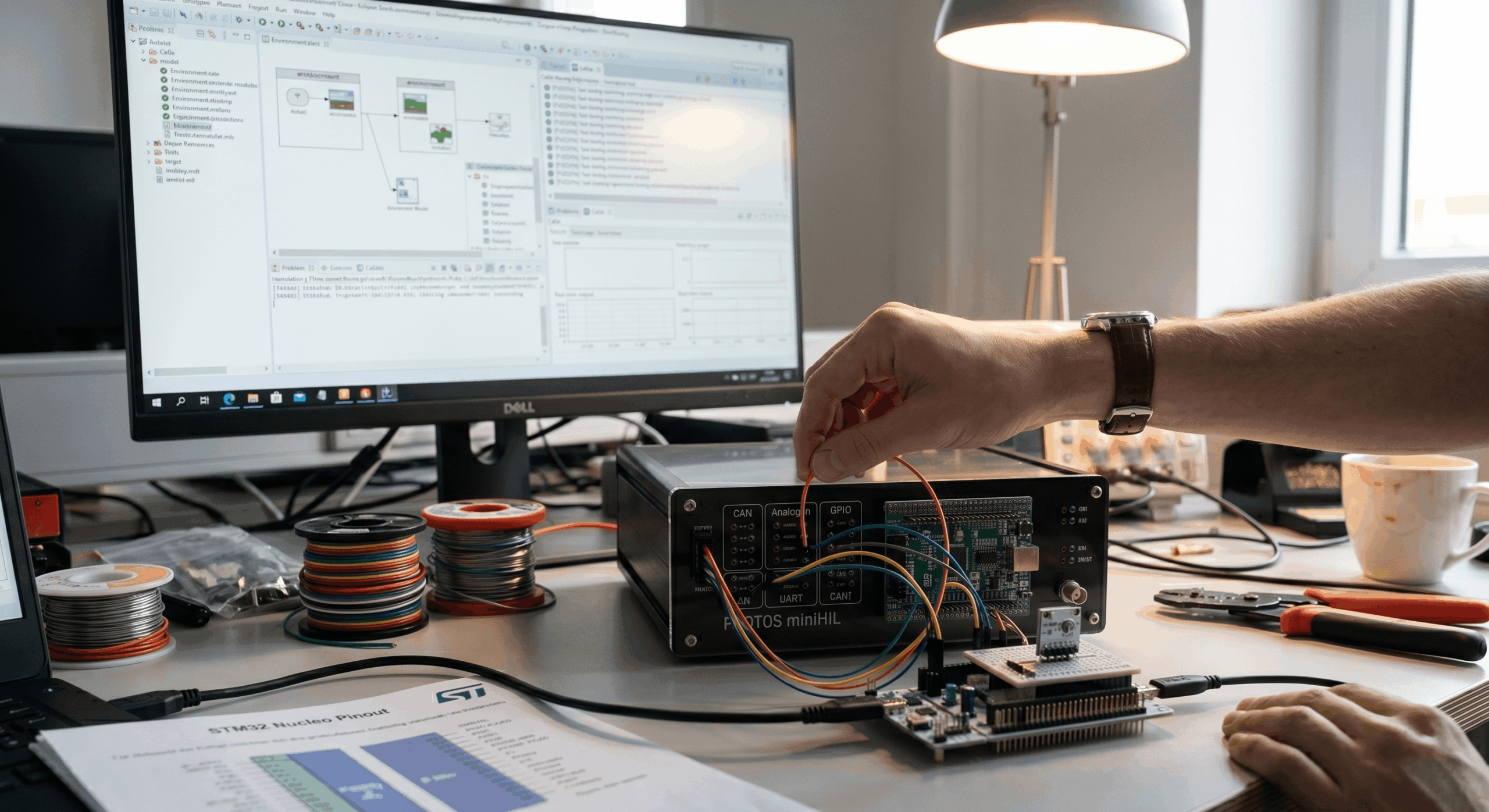
- Connect your evaluation board: Plug in the eval board as the system-under-test. Firmware runs on your actual target microcontroller.
- Wire the interfaces: Connect the target microcontroller's I/O to the miniHIL via the patch panel. Add the optional FPGA board for timing-critical signals.
- Build environment simulations: Model sensors, actuators, and bus protocols using Eclipse eTrice and ROOM. Code is auto-generated and deployed directly to the STM32H7.
- Write and run tests with CaGe: Define test suites using the CaGe DSL. Tests execute automatically and CI triggers the next run on every commit.